Tuesday, August 20, 2013

Monday, June 17, 2013
What is Peter Thiel on about?
Here he's addressing HBS, but he's said the same things other places.

Fundamentally:
Think on a LONGER TIME HORIZON.
What is your 20 year plan?
Come up with a plan, and be the Entrepreneur of your Life
Details

Fundamentally:
Think on a LONGER TIME HORIZON.
What is your 20 year plan?
Come up with a plan, and be the Entrepreneur of your Life
Details
- Just Reducing Risk vs Specific Plans
- New Grads having no real ambition vs Peter saying people need to have a longterm plan
- 1 to n (growth of existing patterns) vs 0 to 1 (something new)
- Globalization vs Technology
- China vs California
- Law/Business School vs Engineering Education
Ask yourself:
- What are the problems that exist in the world,
- That other people are not working on
Peter thinks:
Starting new companies are the best way to solve a large range of these problems
There is a similarity between his argument and my thread of thought regarding our inability to focus on the longer term. His speech makes me want to plan.
Thursday, June 6, 2013


Tuesday, May 21, 2013
BobMetcalfe[S] 9 points 2 hours ago
"Ethernet is going up, into, over, across, and down into new markets. Up toward terabit LAN. Into the WAN killing SONET. Over the airwaves as WiFi. Across the telechasm, between carrier WANs and customer LANs, as Carrier Ethernet. And won into embedded networking, as ZigBee (IEEE 802.15.4)."
Links are mine.
From http://www.reddit.com/r/IAmA/comments/1erq51/youre_probably_connecting_to_reddit_through_a/ca33i7q
Links are mine.
From http://www.reddit.com/r/IAmA/comments/1erq51/youre_probably_connecting_to_reddit_through_a/ca33i7q
Thursday, May 16, 2013
probability distributions and what they model
DISCRETE
Bernoulli distribution, discrete probability distribution, which takes value 1 with success probability and value 0 with failure probability
 .
. binomial distribution is the discrete probability distribution of the number of successes in a sequence of n independent yes/no experiments, each of which yields success with probabilityp.
Such a success/failure experiment is also called a Bernoulli experiment or Bernoulli trial; when n = 1, the Bernoulli distribution is a binomial distribution. The binomial distribution is the basis for the popular binomial testof statistical significance.
negative binomial distribution is a discrete probability distribution of the number of successes in a sequence of Bernoulli trials before a specified (non-random) number of failures (denoted r) occurs. For example, if we define a "1" as failure, and all non-"1"s as successes, and we throw a dierepeatedly until the third time “1” appears (r = three failures), then the probability distribution of the number of non-“1”s that had appeared will be negative binomial.
Poisson distribution (pronounced [pwasɔ̃]) is a discrete probability distribution that expresses the probability of a given number of events occurring in a fixed interval of time and/or space if these events occur with a known average rate and independently of the time since the last event
The categorical distribution is the generalization of the Bernoulli distribution for a categorical random variable, i.e. for a discrete variable with more than two possible outcomes.
multinomial distribution is a generalization of the binomial distribution. For nindependent trials each of which leads to a success for exactly one of k categories, with each category having a given fixed success probability, the multinomial distribution gives the probability of any particular combination of numbers of successes for the various categories.
hypergeometric distribution is a discrete probability distribution that describes the probability of
 successes in
  draws without replacement from a finite population of size
  containing a maximum of
  successes. This is in contrast to the binomial distribution, which describes the probability of successes in draws with replacement.
geometric distribution is either of two discrete probability distributions:
- The probability distribution of the number of X Bernoulli trials needed to get one success, supported on the set { 1, 2, 3, ...}
- The probability distribution of the number Y = X − 1 of failures before the first success, supported on the set { 0, 1, 2, 3, ... }
Continuous
normal (or Gaussian) distribution is a continuous probability distribution, defined by the formula
- With a shape parameter k and a scale parameter θ.
- With a shape parameter α = k and an inverse scale parameter β = 1/θ, called a rate parameter.
- With a shape parameter k and a mean parameter μ = k/β.

multivariate normal distribution or multivariate Gaussian distribution, is a generalization of the one-dimensional (univariate) normal distribution to higher dimensions
continuous uniform distribution or rectangular distribution is a family of symmetric probability distributions such that for each member of the family, all intervals of the same length on the distribution's support are equally probable. The support is defined by the two parameters, a and b, which are its minimum and maximum values
Pareto distribution, named after the Italian economist Vilfredo Pareto, is a power law probability distribution that is used in description of social, scientific, geophysical, actuarial, and many other types of observable phenomena
Weibull distribution /ˈveɪbʊl/ is a continuous probability distribution. It is named after Waloddi Weibull, who described it in detail in 1951, although it was first identified by Fréchet (1927) and first applied by Rosin & Rammler (1933) to describe a particle size distribution
log-normal distribution is a continuous probability distribution of a random variablewhose logarithm is normally distributed
exponential distribution (a.k.a. negative exponential distribution) is a family of continuous probability distributions. It describes the time between events in a Poisson process, i.e. a process in which events occur continuously and independently at a constant average rate. It is the continuous analogue of the geometric distribution.
gamma distribution is a two-parameter family of continuousprobability distributions. There are three different parameterizations in common use:
In each of these three forms, both parameters are positive real numbers.
The parameterization with k and θ appears to be more common in econometrics and certain other applied fields, where e.g. the gamma distribution is frequently used to model waiting times. For instance, in life testing, the waiting time until death is a random variable that is frequently modeled with a gamma distribution.[1]
The parameterization with α and β is more common in Bayesian statistics, where the gamma distribution is used as a conjugate prior distribution for various types of inverse scale (aka rate) parameters, such as the λ of an exponential distribution or a Poisson distribution – or for that matter, the β of the gamma distribution itself. (The closely related inverse gamma distribution is used as a conjugate prior for scale parameters, such as the variance of a normal distribution.)
If k is an integer, then the distribution represents an Erlang distribution; i.e., the sum of k independentexponentially distributed random variables, each of which has a mean of θ (which is equivalent to a rate parameter of 1/θ).
beta-binomial distribution is a family of discrete probability distributionson a finite support of non-negative integers arising when the probability of success in each of a fixed or known number of Bernoulli trials is either unknown or random. It is frequently used in Bayesian statistics, empirical Bayes methods and classical statistics as an overdispersed binomial distribution
Wednesday, May 15, 2013
improving coordinate system representation
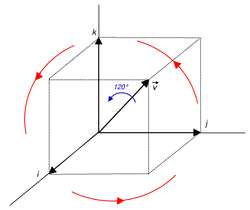
I knew there was something fascinating about Quaternions but I could only vaguely remember even the name. The promise of a fundamental "new" (to me) insight about geometric representation. Turns out the wiki article contains the solution to a problem that has been a minor irritation to me for years: "degeneracy in coordinate system behaviour".


The Newfound Solution: To avoid degeneracy in coordinate system behaviour, just go add one dimension to the representation!
Its so brilliant that Im angry I didnt discover it myself.
From http://en.wikipedia.org/wiki/Quaternions_and_spatial_rotation
"We can parameterize the surface of a sphere with two coordinates, such as latitude and longitude. But latitude and longitude are ill-behaved (degenerate) at the north and south poles, though the poles are not intrinsically different from any other points on the sphere. At the poles (latitudes +90° and −90°), the longitude becomes meaningless.
It can be shown that no two-parameter coordinate system can avoid such degeneracy. We can avoid such problems by embedding the sphere in three-dimensional space and parameterizing it with three Cartesian coordinates (w, x, y), placing the north pole at(w, x, y) = (1, 0, 0), the south pole at (w, x, y) = (−1, 0, 0), and the equator at w = 0, x2 + y2 = 1. Points on the sphere satisfy the constraint w2 + x2 + y2 = 1, so we still have just two degrees of freedom though there are three coordinates."
"We can parameterize the surface of a sphere with two coordinates, such as latitude and longitude. But latitude and longitude are ill-behaved (degenerate) at the north and south poles, though the poles are not intrinsically different from any other points on the sphere. At the poles (latitudes +90° and −90°), the longitude becomes meaningless.
It can be shown that no two-parameter coordinate system can avoid such degeneracy. We can avoid such problems by embedding the sphere in three-dimensional space and parameterizing it with three Cartesian coordinates (w, x, y), placing the north pole at(w, x, y) = (1, 0, 0), the south pole at (w, x, y) = (−1, 0, 0), and the equator at w = 0, x2 + y2 = 1. Points on the sphere satisfy the constraint w2 + x2 + y2 = 1, so we still have just two degrees of freedom though there are three coordinates."
Bonus article on Gimbal lock:

Tuesday, April 9, 2013
Go does Hoare
Thomas Kappler rewrote the examples in Tony Hoare's famous CSP paper in Google's recent Go language.
The result is some incredibly elegant code, especially considering what solutions might look like in languages that don't have sweet concurrency mechanisms like Go channels. Concurrent programming easy as bash pipes? BLAM!!
Fave quote:

The result is some incredibly elegant code, especially considering what solutions might look like in languages that don't have sweet concurrency mechanisms like Go channels. Concurrent programming easy as bash pipes? BLAM!!
Fave quote:
// The implementation in four lines is a testament to the expressive// power of modeling programs as communicating sequential processes.func S36_Conway(cardfile, lineprinter chan []rune) {pipe1, pipe2 := make(chan rune), make(chan rune)go S33_DISASSEMBLE(cardfile, pipe1)go S32_SQUASH_EXT(pipe1, pipe2)S34_ASSEMBLE(pipe2, lineprinter)}

Sunday, March 17, 2013
what would Polya do?
It turns out there is a whole genre of problem solving frameworks. Many represent "business paperback" level thinking and clearly wouldn't be much help doing anything difficult.

How to Solve It (1945) is a famous little volume by mathematician George Pólya describing general methods of problem solving. I particularly like his heuristic approach:
I like this book so much I have a page of it stuck to my office wall. Every once in a while I look at it when stuck, and sometimes it inspires a new perspective.

How to Solve It (1945) is a famous little volume by mathematician George Pólya describing general methods of problem solving. I particularly like his heuristic approach:
| Heuristic | Informal Description | Formal analogue |
| Analogy | Can you find a problem analogous to your problem and solve that? | Map |
| Generalization | Can you find a problem more general than your problem? | Generalization |
| Induction | Can you solve your problem by deriving a generalization from some examples? | Induction |
| Variation of the Problem | Can you vary or change your problem to create a new problem (or set of problems) whose solution(s) will help you solve your original problem? | Search |
| Auxiliary Problem | Can you find a subproblem or side problem whose solution will help you solve your problem? | Subgoal |
| Here is a problem related to yours and solved before | Can you find a problem related to yours that has already been solved and use that to solve your problem? | Pattern recognition Pattern matching Reduction |
| Specialization | Can you find a problem more specialized? | Specialization |
| Decomposing and Recombining | Can you decompose the problem and "recombine its elements in some new manner"? | Divide and conquer |
| Working backward | Can you start with the goal and work backwards to something you already know? | Backward chaining |
| Draw a Figure | Can you draw a picture of the problem? | Diagrammatic Reasoning [28] |
| Auxiliary Elements | Can you add some new element to your problem to get closer to a solution? | Extension[disambiguation needed] |
I like this book so much I have a page of it stuck to my office wall. Every once in a while I look at it when stuck, and sometimes it inspires a new perspective.
Wicked Problems are NP Complete
Tim O'Reilly famously encouraged software startups to focus on solving big, hard problems. Which are sometimes referred to as "Wicked Problems", which I have written more about here and here on my "political" blog.
There is an interesting analogy between the real world wicked problems we face, and complexity theory in computer science. In CS, some of the hardest problems are called "NP Complete", and we usually don't even attempt to solve them perfectly. Instead, we use techniques like heuristics, and are often pleased to find a reasonable solution in a reasonable time, instead of insisting on the optimal solution, which could take longer than the expected lifespan of the universe to find.
I think this metaphor yields some interesting thoughts.
There is an interesting analogy between the real world wicked problems we face, and complexity theory in computer science. In CS, some of the hardest problems are called "NP Complete", and we usually don't even attempt to solve them perfectly. Instead, we use techniques like heuristics, and are often pleased to find a reasonable solution in a reasonable time, instead of insisting on the optimal solution, which could take longer than the expected lifespan of the universe to find.
Rihanna knows NP-complete problems can get complicated fast
I think this metaphor yields some interesting thoughts.
- In both cases we need to quickly recognize the inherent difficulty of the problem and give up on finding a perfect solution, otherwise we risk wasting precious resources. On the other hand, even just "ok" solutions can be far more valuable than none at all.
- Solving by heuristic is quite different than solving for an exact solution. Tackling NP-complete problems requires a very different perspective, one that gets more comfortable after spending more time on such problems. In CS some people specialize in NP-complete problems and heuristics, and they have whole vocabularies and toolkits that are unfamiliar to those used to conventional problems. So it is reasonable to think that dealing with wicked problems, though difficult, is an acquired skill that can be refined.
- In CS there are proofs that link many NP-complete problems together, essentially stating that these many different hard problems are in fact different forms of each other, and these problems can be transformed from one to another. Finding an exact solution to one, would solve the whole bunch. The analogous statements for Wicked Problems might be that WPs share common elements at their root, they should be considered as a set, and solving one may help solve others. This one is by far my favourite, and made the whole analogy worthwhile IMO.
 |
| Could the many wicked problems, like NP-complete ones, be different faces of the same monster? A terrifying thought, full of hope. |
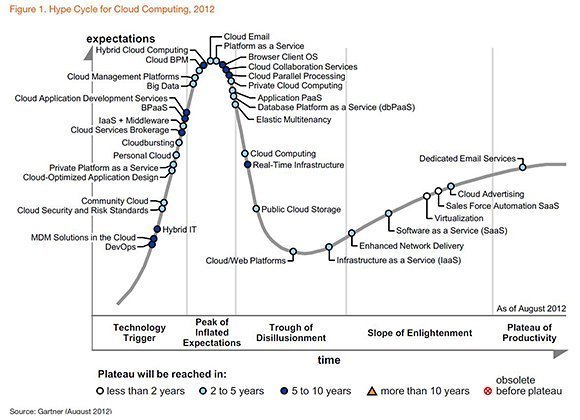
Cloud computing hype cycles 2010-2012 according to Gartner
Usually we only see one hype cycle at a time. I find it interesting to look at a few years to see trends.
Note this is specifically the Cloud Computing cycle, I've also got another post with the overall hype cycles for the last few years.
A few takeaways:
2012:

2011:

2010:

Note this is specifically the Cloud Computing cycle, I've also got another post with the overall hype cycles for the last few years.
A few takeaways:
- Its funny how dated 2011 and 2010 look now. "Multitenancy" as an early stage technology in 2011?
- Real-time infrastructure hasn't moved (?)
- Cloud security and risk standards are finally in the picture
- Buzzwords galore
2012:
2011:

2010:

Subscribe to:
Posts (Atom)